
I Feel
Colorings and Coincidences
Everyone is coloring, it’s hard to see sometimes, but everyone is. You can see coloring in reflections or outright pictures. Time stamps or light bulbs turned off. Even the invisible around the corner. The colorings and coincidences made and never quite understood. Copyright - Susy Kamber All rights reserved Song Selection - Bird Gerhl (Live) Antony and tge Johnson & ANOHNI This reads like a meditation on how everyone leaves traces, even when they think they’re unseen. “Everyone is coloring” Coloring here feels metaphorical—each person is adding tone, influence, or meaning to the world simply by existing. It suggests agency, whether intentional or not. “It’s hard to see sometimes” Not all influence is obvious. Much of what people add is subtle, layered, or obscured by noise and distraction. “You can see coloring in reflections or outright pictures” Some truths appear indirectly—reflections, mirrors, photographs, memories—while others are blatant and documented. This contrasts perception versus proof. “Time stamps or light bulbs turned off” These are quiet markers of presence and absence. A timestamp proves something happened; a darkened bulb shows someone was once there. Evidence without explanation. “Even the invisible around the corner” There’s acknowledgment of what we sense but cannot yet see—anticipation, intuition, unseen consequences. “The colorings and coincidences made and never quite understood” Meaning accumulates unintentionally. Patterns form without full awareness. Life creates intersections that feel purposeful but resist complete interpretation. Overall The passage suggests that nothing is neutral—everyone alters the world in small, often unrecognized ways. Meaning is created constantly, but understanding lags behind creation. It’s reflective, slightly mysterious, and gently existential, accepting that full clarity may never arrive—and that’s part of the human condition.
2025
Photograph
Reverie
According to philosopher John Armstrong, “Reverie is the state of giving ourselves up to the flow of associations. This state of letting something happen—a species of relaxation—is one we need to cultivate when we look at paintings or buildings. . . . Reverie is a mode of introducing personal material into a picture or building: it brings an abundance of thoughts and feelings into play. It also frees us from merely following routine assumptions. . . . Reverie operates at the root of thinking: it is essential to the creative process in which we come to make thoughts for ourselves.”
Photograph
I Feel
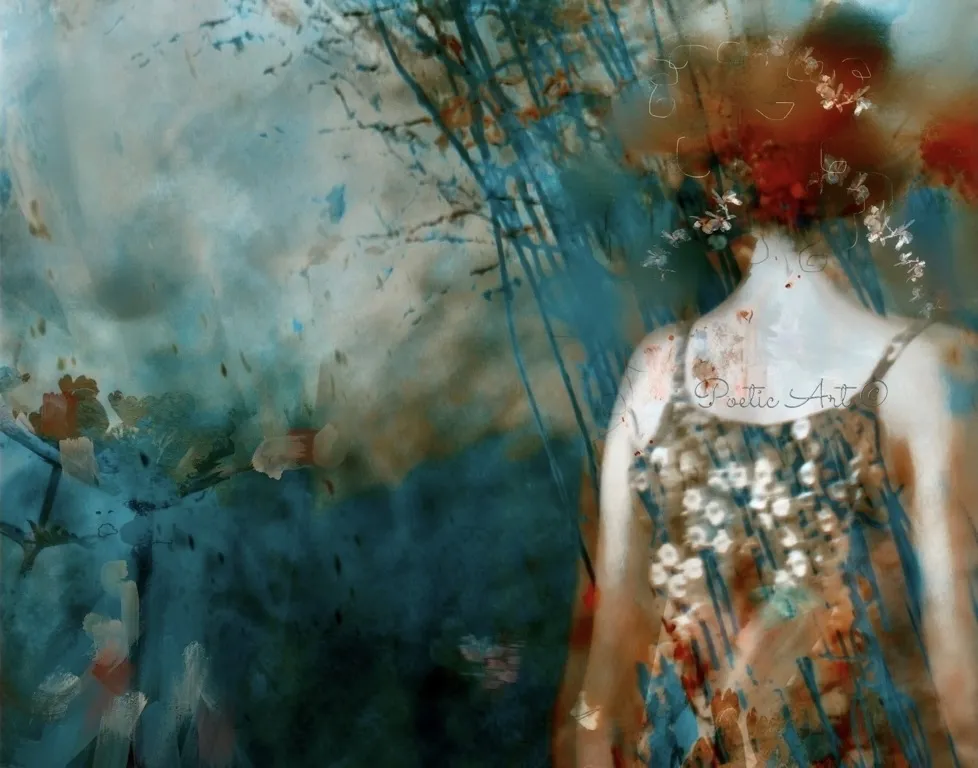
I don't know how to feel this place. Is it in the dust that exists there, a way to become opaque, unknown and forgotten. A camouflaged person mixed into the earth. Forming me into another part. Is it in the clouds aching to lower themselves, so I can walk through and be mystified, the unknown and forgotten in me awakened. Can I see into the holes without holding a candle? Or just stare at the opening wondering if darkness would turn me black as the night. Now opaque in that form. Yet, in not knowing how to feel this place. The stasis of hope longing to be free, awakens. I touch the dust, I paint the clouds. I sense the holes. I feel. Copyright - Susy Kamber All rights reserved Song Selection - Nancy Galbraith "Effervescent Air" by Nancy Galbraith features electric Baroque flute, amplified piano, Baroque string orchestra and percussion. World premiere on 15 November 2012. Stephen Schultz (flute), Luz Manriquez (piano), Carnegie Mellon Baroque Orchestra, Daniel Curtis (conductor), Sang Mok Lee (sound design).
2025
Photograph