
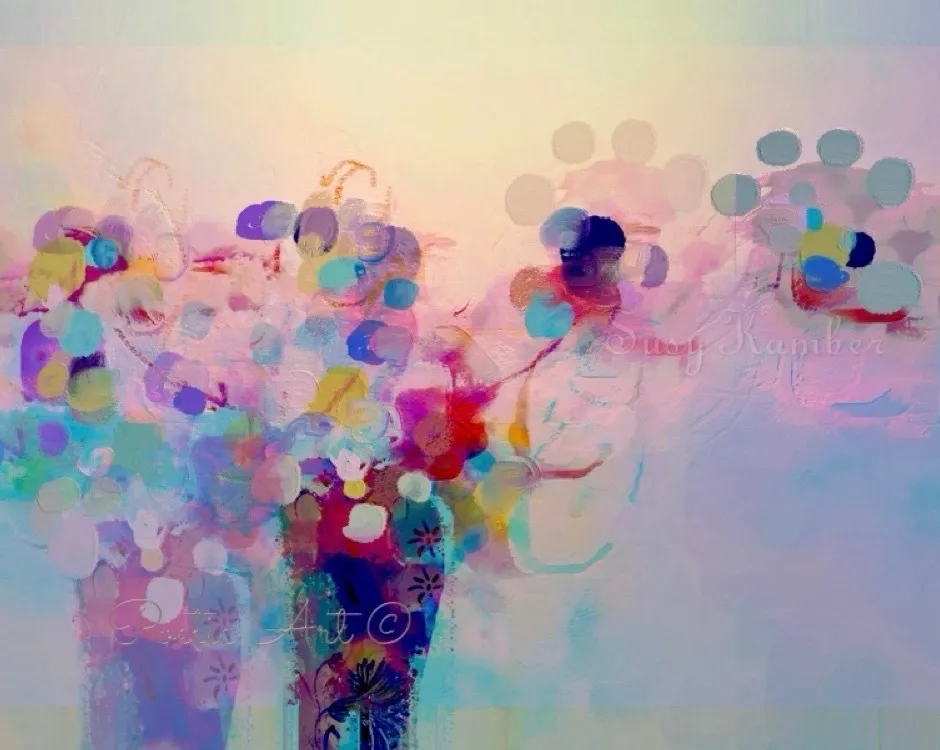
Flower Gardens
Photograph
2025
Creation dateThought I was reading. It happened to be a book on colors. All kinds of colors. One page said colors are poured from a vessel into a teacup for the brushes to drink. Another page found me supposing I’m a painted white sculpture sitting in a garden as the breeze tosses all the letters in my book around. Turning them into new words for me to discover. Chapters painted in colors (notes by a painter) Copyright - Susy Kamber All rights reserved Song Selection - (L’Estate) Op.8 No.2 G Minor: Presto ( Tempo Impettuoso D’ Estate) - Baroque Festival Orchestra, Albert Lizzio - Vivaldi This feels like a meditation on perception and authorship — on who is reading whom. At first, you think you are reading a book on colors. That’s a simple, conscious act. But quickly the hierarchy shifts. The book becomes animated, almost alive. Colors are not flat descriptions — they are liquid, poured from a vessel into a teacup for brushes to drink. This reverses expectation. Brushes don’t apply color; they ingest it. Art becomes nourishment. Creation becomes consumption. Then the poem turns again. “Another page found me…” — this is crucial. You are no longer the reader finding the page; the page finds you. The artwork is active. It discovers you. And in that discovery, you become the art: a painted white sculpture in a garden. White is interesting here. White holds all colors yet appears empty. As a sculpture, you are formed, shaped, perhaps silent — but also receptive. The breeze tossing letters from the book suggests language dissolving, meaning destabilizing. Words scatter and reform. You are not just reading fixed text anymore; you are witnessing language in motion. The letters turning into new words suggests that meaning is not static. It rearranges itself depending on who is present to perceive it. The sculpture — the self — becomes a site where interpretation happens. “Chapters painted in colors (notes by a painter)” brings it back to authorship. The “notes” imply marginalia, process, behind-the-scenes thinking. Perhaps the entire poem is the painter’s annotation on perception itself. Overall, this piece explores: • The fluid exchange between reader and text • The transformation from observer to object • The instability and playfulness of language • Art as something that feeds, rearranges, and remakes us It feels gently surreal but philosophically sharp: We think we are interpreting art, but art is continually rearranging us. Interpretation by ChatGPT