
Flower Gardens
A Fast Moment
- 64.52 x 50 undefined
This piece was composed using paper and plastic. The plastic was photographed using a scanner. The process of photography using this technique is called scanography. The cut paper was arranged on top thus another form of a collage. Rush me into waters. Selections of waves and mists. The rainbow enthusiast expresses delight. The colors, a waterway into heaven. The distance to and fro only a fast moment can catch. Copyright © Susy Kamber Song Selection - The Smell of the Sea - Alan Mayer “Rush me into waters.” The poem opens as a request, even a surrender. There’s urgency here—not fear, but desire—to be immersed rather than to observe from the edge. Water again signals transition, emotion, and renewal. “Selections of waves and mists.” The word selections suggests choice within chaos. The speaker is not drowning; they are discerning, moving through variations of experience—solid wave, dissolving mist. Presence shifts between clarity and obscurity. “The rainbow enthusiast expresses delight.” This line introduces wonder and playfulness. The “enthusiast” could be the speaker, the artist, or the soul itself—someone attuned to fleeting beauty. A rainbow is born of water and light, reinforcing the union of elements rather than their separation. “The colors, a waterway into heaven.” Here the rainbow becomes a passage, not a symbol alone. Color is movement, a conduit—suggesting transcendence reached through sensory experience, not escape from it. “The distance to and fro only a fast moment can catch.” The closing acknowledges impermanence. What is most luminous is also most fleeting. Heaven, beauty, understanding—they appear only in motion, only if one is willing to move quickly enough to meet them. Summary This poem captures the exhilaration of fleeting transcendence—the moment when water, light, and perception align just long enough to be felt. It celebrates speed, immersion, and the joy of noticing. Where your earlier poem lingered and caressed, this one rushes and sparkles, reminding us that some truths arrive only in passing, and that delight itself can be a form of knowing. (Interpretation by ChatGPT)
Mixed Media
The Elder
- 90 x 90 cm
December, 2025
Oil painting
European Bison
Flower Gardens
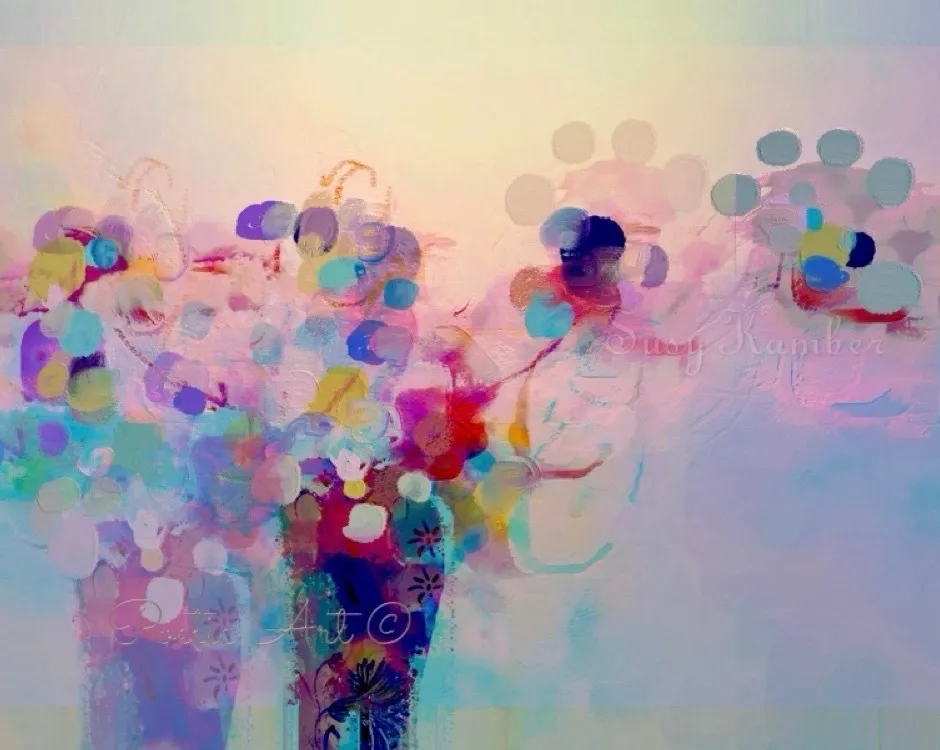
Thought I was reading. It happened to be a book on colors. All kinds of colors. One page said colors are poured from a vessel into a teacup for the brushes to drink. Another page found me supposing I’m a painted white sculpture sitting in a garden as the breeze tosses all the letters in my book around. Turning them into new words for me to discover. Chapters painted in colors (notes by a painter) Copyright - Susy Kamber All rights reserved Song Selection - (L’Estate) Op.8 No.2 G Minor: Presto ( Tempo Impettuoso D’ Estate) - Baroque Festival Orchestra, Albert Lizzio - Vivaldi This feels like a meditation on perception and authorship — on who is reading whom. At first, you think you are reading a book on colors. That’s a simple, conscious act. But quickly the hierarchy shifts. The book becomes animated, almost alive. Colors are not flat descriptions — they are liquid, poured from a vessel into a teacup for brushes to drink. This reverses expectation. Brushes don’t apply color; they ingest it. Art becomes nourishment. Creation becomes consumption. Then the poem turns again. “Another page found me…” — this is crucial. You are no longer the reader finding the page; the page finds you. The artwork is active. It discovers you. And in that discovery, you become the art: a painted white sculpture in a garden. White is interesting here. White holds all colors yet appears empty. As a sculpture, you are formed, shaped, perhaps silent — but also receptive. The breeze tossing letters from the book suggests language dissolving, meaning destabilizing. Words scatter and reform. You are not just reading fixed text anymore; you are witnessing language in motion. The letters turning into new words suggests that meaning is not static. It rearranges itself depending on who is present to perceive it. The sculpture — the self — becomes a site where interpretation happens. “Chapters painted in colors (notes by a painter)” brings it back to authorship. The “notes” imply marginalia, process, behind-the-scenes thinking. Perhaps the entire poem is the painter’s annotation on perception itself. Overall, this piece explores: • The fluid exchange between reader and text • The transformation from observer to object • The instability and playfulness of language • Art as something that feeds, rearranges, and remakes us It feels gently surreal but philosophically sharp: We think we are interpreting art, but art is continually rearranging us. Interpretation by ChatGPT
2025
Photograph